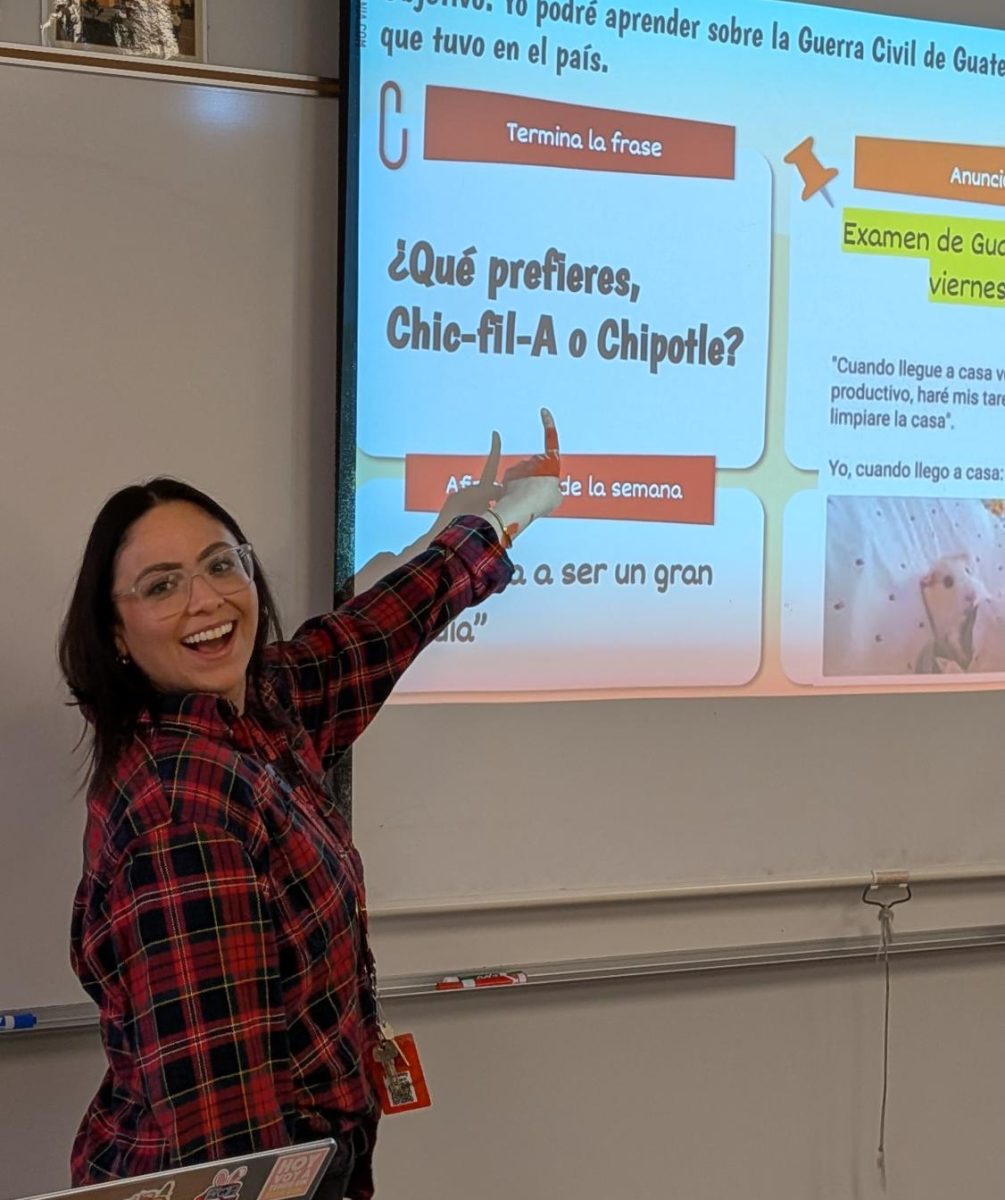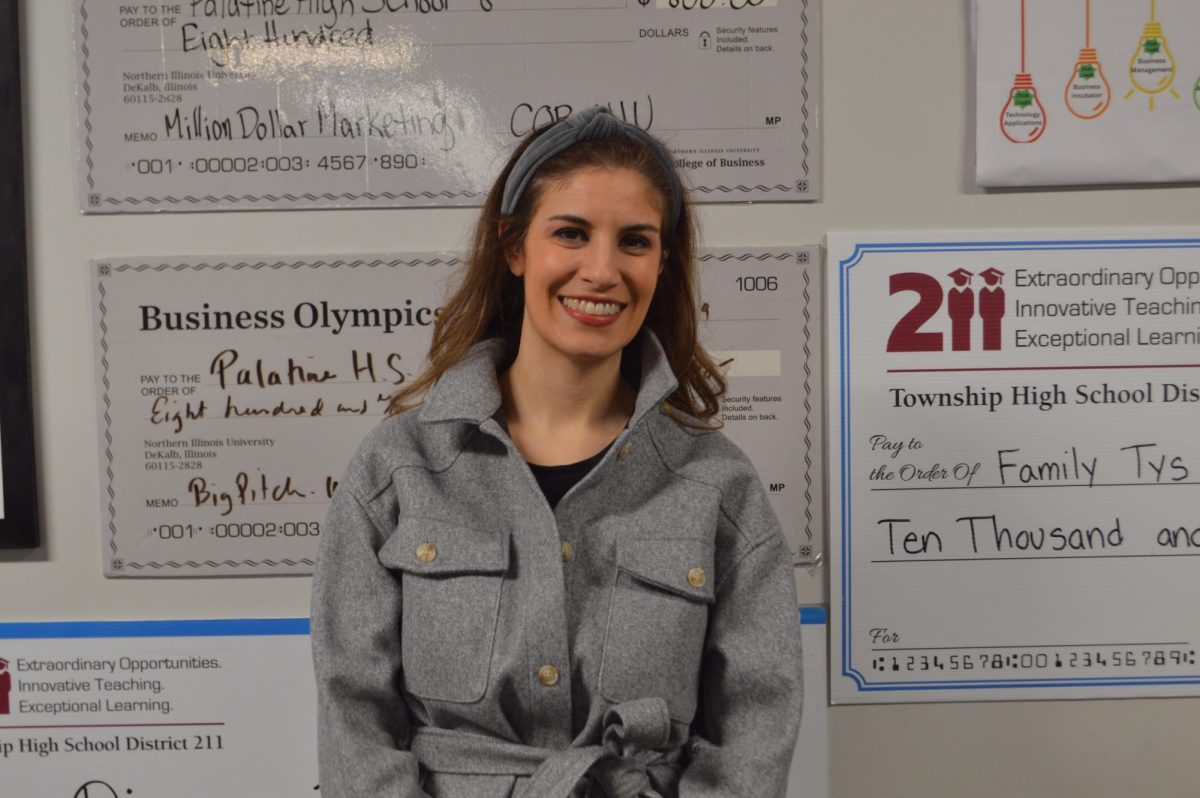
When only four girls were enrolled in marketing classes, Adrienne Stewart knew something had to change.
So she created Beauty Marketing, a course that merged foundational business principles with an industry that directly resonated with female students. The result? Female enrollment is now more than 40% across her marketing classes.
This is the kind of creative problem-solving and vision that has defined Stewart’s 19-year career at Palatine High School, where she now leads the business department with a clear mission: make business education accessible and relevant to every student who walks through her door.
“She walks into work with a smile on her face each day with a servant leadership mentality, asking us what she can do for us to make us more successful,” Roger Lane, a fellow business teacher and colleague of Stewart, said. “How she brings out the full potential of her students is very similar to how she brings out the fullest potential of her employees. We strive to go the extra mile for her because we know she would do the same for us.”
This philosophy was born within her own journey. Growing up in Palatine, Stewart graduated from Palatine High School in 2003. While pursuing a business degree in college, she discovered her calling to education and made a choice that would define her career. She came back to Palatine, walking the halls as a teacher where she’d once been a student.
Stewart brought back with her a teaching philosophy centered on one principle: helping students understand the ‘why’ behind everything they learn.
“I try to always start with the why and make that very clear to kids,” Stewart said. “If your why falters a little bit or is unclear, it’s never going to be a strong foundation.”
Students feel the impact of this approach. Junior Sammie Barjon, who took Stewart’s beauty marketing class, sees how Stewart’s energy and accessibility transform learning.
“Mrs. Stewart is always happy to teach; she loves it when people ask questions because she’ll always give the best answers, and her personality in the classroom is very bright and energetic,” Barjon said. “I loved having beauty marketing with her mainly because of her outgoing, bubbly personality. It made the class 10 times better.”
Stewart consistently applies this principle with a deeply human touch. Whether teaching AP Seminar or marketing courses, she strives to communicate the purpose and reasoning behind what students are learning and push them to dig deeper than surface-level understanding.
Alongside this, Stewart weaves in lessons about creativity, connection, and what it means to be a human in an increasingly technological world. In an age where artificial intelligence can generate essays and solve problems, she believes students need something deeper: the ability to think critically, collaborate authentically, and lead with a purpose.
“It’s my job to make sure that we can collaborate, human to human, that we can talk human to human, and that students can articulate their thoughts as a human,” Stewart said.
That philosophy shapes how she builds opportunities for students. Identifying the need for real-world connections across her business classes, Stewart has devoted herself to delivering just that.
“Before taking this class, I didn’t know what I wanted to do after high school,” Theresa Cortez, a junior who took Stewart’s Beauty Marketing class, said. “Her class gave me an opportunity to figure out what type of career I want to pursue in the future, which is now a marketing career!”
Organizing an industry panel that connected students across the district to professionals in the beauty industry and her hands-on career field trips, Stewart exposes students to developmental experiences that shape their career path.
As a sponsor of Future Business Leaders of America (FBLA), she continues her nearly two-decade commitment to competitive business education, guiding students through events in foundational concepts while instilling confidence in them that they carry throughout their lives.
But perhaps her most transformative work happens through Project Excel, a program she’s co-sponsored for nearly 15 years. The program supports first-generation students, those whose parents did not attend college in the United States, as they navigate the complex journey to higher education.
Alongside fellow sponsor Alonso Ramirez, Stewart guides students through college preparation, applications, and financing. They run summer classes and organize frequent workshops, teaching life skills and instilling confidence in students who might otherwise feel lost in the process.
“We are at a point that our graduates are now coming back and returning to the program in the form of mentorship, and so they’re basically proof of our program,” Stewart said. “It makes you feel worth it, like you did something that really changed someone’s life.”
Stewart emphasized that graduates of the program who have gone on to succeed in their careers continue to express gratitude for the work of Stewart and staff in the developmental experiences that Project Excel provides. Stewart recalls one alumnus who went on to have a successful career and graciously secured $10,000 in funding for the program.
For Stewart, the measure of success lies ahead. She is energized by the possibilities of restarting her Women in Business initiatives, including a lecture series, which previously brought female executives to campus. Additionally, alongside the introduction of classes like AP Business Principles and Real Estate, Stewart is diligently exploring partnerships and opportunities to provide the most realistic business experiences to students.
Her ability to scale the enrollment of girls in marketing highlights the impact of her philosophy. But the real story is being written, in every classroom discussion, every FBLA competition, every first-generation student who discovers they belong, every girl who sees herself as a future business leader.
Stewart is not just teaching concepts; she is teaching students to find their why and showing them that when they do that everything else follows.