Skip to Content
Categories:

From Copy-Paste to AI: How PHS is navigating academic integrity

2000s: For the 150th anniversary of Palatine High School, Cutlass is exploring the decades
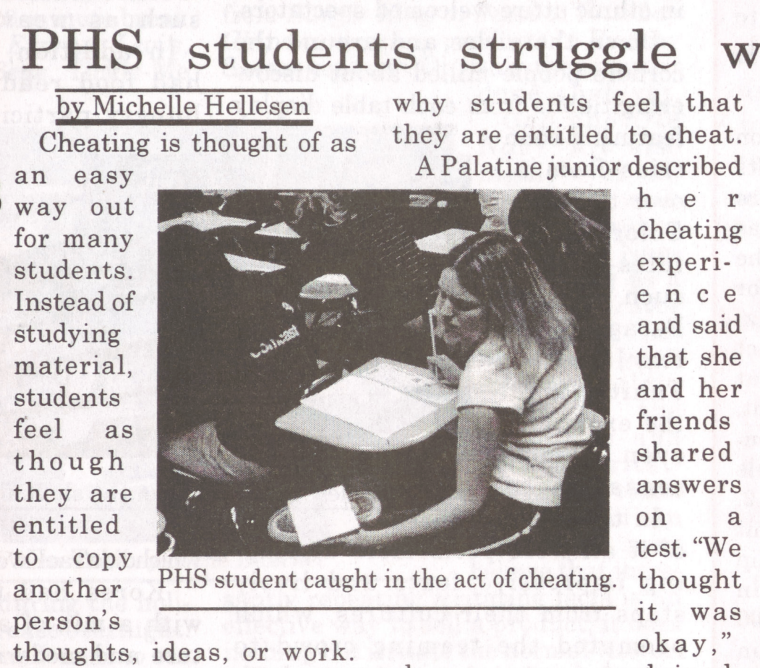
Features article captures Palatine student caught cheating in the 2000s.
Archive The Cutlass December 2003
Features article details the introduction of computer labs at Palatine in the 2000s.

The early 2000s marked a shift inside Palatine High School classrooms.

The internet was growing and PHS students now had access to endless information right at their fingertips, more than any previous generation ever had. As hundreds of computers were added to the building and software installed, nobody anticipated what some students would do with it.

Students would often take advantage of the powers of the internet to cheat in school. 

“Writing a paper has become as easy as clicking the cut and paste keys in Microsoft Word,” the Cutlass editorial board said in April 2002. 

The method was simple: find a paper online, copy it into a Word document, put your name on it, and hand it in. These individuals would not rewrite or paraphrase; they would simply copy and paste. The internet has made cheating easier and, as an entirely new practice, hard to prevent.
Features article details the introduction of computer labs at Palatine in the 2000s. (Archive The Cutlass November 2000)
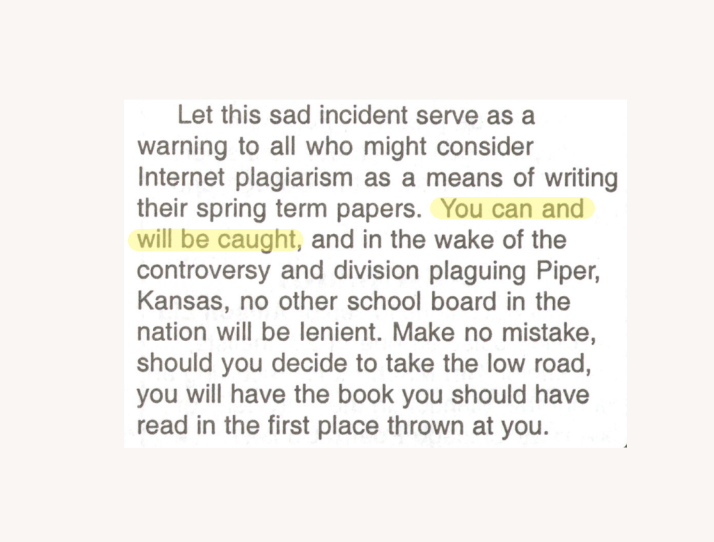
Opinions article warning Palatine students in the 2000s of the risks of plagiarism.

Over time, this practice only strengthened. Over a year later in Dec. 2003, Cutlass reporter Michelle Hellesen found that this had become increasingly prevalent.

What was most concerning was not the act itself, but how unnoticed it went. The advent of the internet made these methods nearly undetectable. However, in due time, the same technology advanced to counteract these same methods. Helleson noted that teachers could type a phrase from a suspicious paper directly into a search engine and find the original source within seconds. Detection software emerged and improved, making plagiarism easier to trace.

“You can and will be caught,” The Cutlass editorial board said in 2002.

At the time, District 211’s academic integrity policy was set in place. A goal to “promote self-confidence, self-esteem, and pride” and to “instill life-long ethics.” 

These rules were longstanding and firm, but as the software improved, this policy began to evolve.
Opinions article warning Palatine students in the 2000s of the risks of plagiarism. (Archive The Cutlass December 2002)

Alex Larson has spent 20 years at PHS, with the last three as technology department chair, overseeing both the school’s technology infrastructure and AI implementation. He manages the tools students use every day. He also remembers fondly what it felt like to be a student in the 2000s navigating the internet for the first time.

Larson was a PHS senior in 2002, the same year the Cutlass editorial board detailed the copy-paste plagiarism spreading around the school.

“I actually recall those articles being put out,” he said. “There was an issue where students would go off and find a paper, find research, and just copy paste it over as their own work, even though it was nowhere near their own work.”

Over two decades later, the method has changed but the same concerns have not.

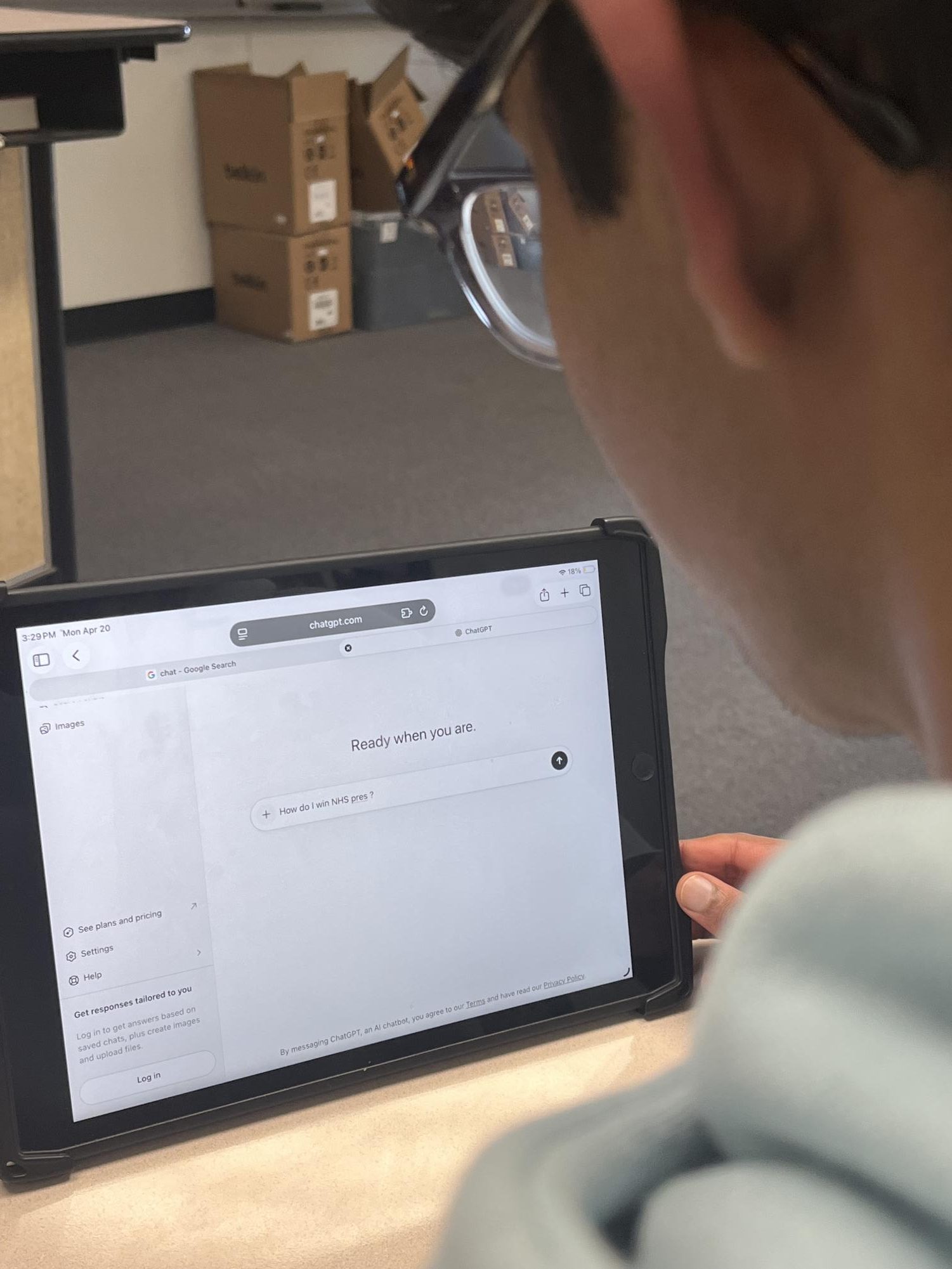
Palatine student using ChatGPT to brainstorm ideas for a homework assignment.

When ChatGPT and other AI tools became widely available, the question of academic integrity at PHS shifted again. 

“From what I have seen, AI has become almost a default first step for a lot of students,” junior Rebecca Garuba said. “Before they even pick up a pencil or open a document, they are asking ChatGPT what to do. I think using it to brainstorm is fine because it just gives students a starting point for their schoolwork.”

In many cases, however, AI is used beyond simple brainstorming. The fundamental issue remains the same, students reaching for the easiest way to get their work done. 

Just as in 2002, PHS and D211 had to create a response plan. As it turned out, there was not much that could be done.

“The idea of checking for copied work was doable before,” Larson said. “In today’s world with AI, that concept doesn’t work well.”

The detection tools that have emerged are, in Larson’s view, largely unreliable. He pointed to GPTZero, one of the most widely used AI detection tools as an illustration of this issue. 

“It says that parts of the Gutenberg Bible are AI,” he said. 

This brings into question the accuracy of such tools and the ease for true plagiarism to go unnoticed as the tools advance.


Palatine student using ChatGPT to brainstorm ideas for a homework assignment. (Bilguun Javkhlan)

Eric Millstone, who started teaching in 1995, explained that detection has become more about instinct than software. 

“When students start submitting work that does not sound or look like it came from them, it needs to be addressed,” Millstone said. “What many students don’t understand is when they submit something from AI, they’re usually submitting error-free, professional-sounding work, which is not typical of most high school students. If I see a submission that has complex sentences and correct comma usage throughout, red flags immediately go up.”

When such incidents occur, Millstone’s approach is quiet but deliberate. 

“No teacher wants to turn it into a gotcha moment,” Millstone said. 

He gives students the option to come clean. On major assignments, he withholds credit until the work is resubmitted as their own.

Larson described the broader problem and ethical concerns with AI as a black box.

“I put a thing into Google, I get information back. What it does in between is a black box,” Larosn said. “AI is the same. The algorithm that built it is unknown to me as the user.”

As a result of this, it is nearly impossible to catch and detect such end products. Larson’s answer is to stop focusing on the end product. He argues that schools need to shift toward teaching and evaluating the process of how students think, decide, and build their work rather than what they turn in.

“The product of a paper isn’t the thing that teaches you,” Larson said. “It’s the process along the way. The work isn’t the outcome. The work is the process.”

This is a big shift, he acknowledged, that is easier said than done, but he sees it as necessary in the evolving technological landscape.

On District 211’s academic integrity policy, Larson said the district revised it when AI emerged, continues to revise it and believes that PHS is better positioned than most schools nationally. However, he was honest about its limits.

“I do believe there is a definite need for continual revision at every level, the building, the district, the state,” Larson said. “AI is rapidly changing so much, and we are not equipped to handle that pace.”

What Larson was firm on was the cost of being a bystander in the movement. 

“If we don’t look at this critically and continuously,” Larson said, “we’re doing our students a disservice.”

More to Discover