In 1930, an announcement from Lowell Observatory near Flagstaff, Arizona, shocked the world: Astronomers had discovered a ninth planet, Pluto. The news captured global attention and stirred excitement at Palatine High School, where students eagerly sought details about the mysterious new celestial body.
The Spotlight, the student newspaper that would later become Cutlass, quickly reported on the breakthrough, informing readers of a discovery that had been decades in the making.
“The discovery was predicted by mathematical calculations back in 1905 by the late Dr. Percival Lowell, founder of the Lowell Observatory,” the paper wrote. Lowell established the observatory in part to search for the elusive planet, though officials delayed the public announcement until March 14 to ensure their findings were certain.
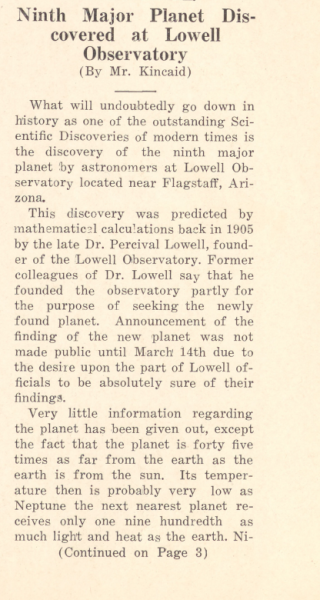
Very little was known about Pluto then. “Its distance is forty-five times as far from the Earth as the Earth is from the Sun,” The Spotlight documented, “and its temperature is probably very low… only very powerful telescopes are able to detect the new planet.”
Though Pluto was reclassified as a dwarf planet in 2006, the discovery remains one of the most significant astronomical moments of the 20th century, capturing the sense of wonder that continues to drive humanity to explore beyond its reach. Even in 1930, The Spotlight captured the curiosity that compels humanity to look beyond the known.
Across the decades, the publication, now known as Cutlass, chronicled humanity’s journey into space. The Space Race of the 1960s and ’70s brought the moon within humanity’s grasp.
“In 1969, humans walked on the moon,” the newspaper reported, “proving that careful observation and bold thinking can reveal worlds hidden from sight.” Student journalists documented every step of the Apollo missions, sharing the technological breakthroughs that redefined space exploration.
In the years that followed, coverage reflected the quieter revolution of the next 50 years. Satellite communications connected the world, interplanetary probes ventured to Mars and Jupiter, and robotic explorers mapped surfaces no human had walked upon. Powerful telescopes revealed distant planets and stars far beyond the solar system. Through each discovery, those stories reached readers, demonstrating that exploration is not just about reaching new worlds but understanding them.
Now, in 2026, the newsroom is preparing to cover humanity’s return to the moon with NASA’s Artemis program. Families, students and enthusiasts may once again look to the sky, feeling the same excitement astronomers experienced when Pluto first appeared through telescopes nearly a century ago. For 100 years, Cutlass has mirrored a century of exploration, preserving these moments for the generations that follow.
Palatine High School will also take an active role in this next chapter with an Artemis II watch party hosted by the science department. The event will feature a live viewing of the launch, discussions of the spacecraft’s capabilities and real-time explanations from science teachers. Attendees will have access to telescopes, food and related lectures, weather permitting.
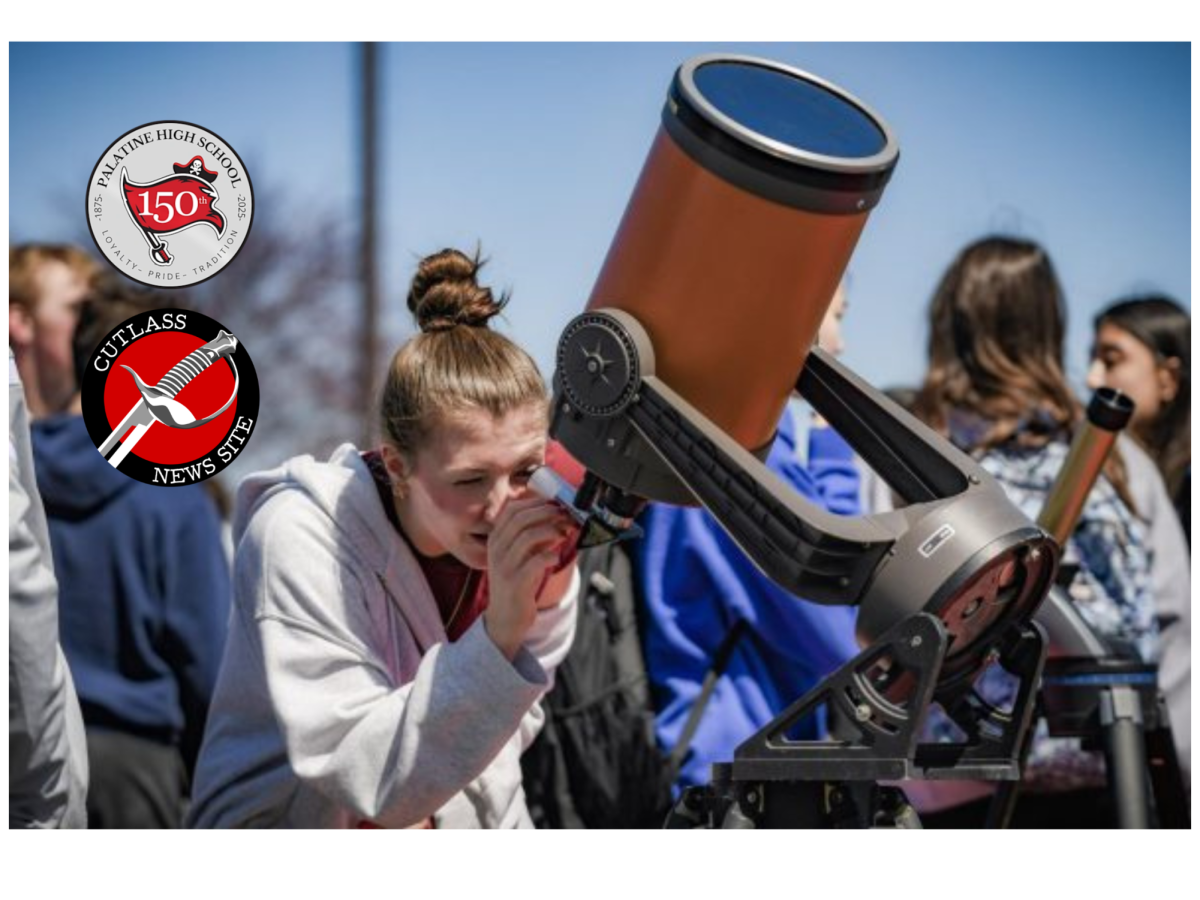
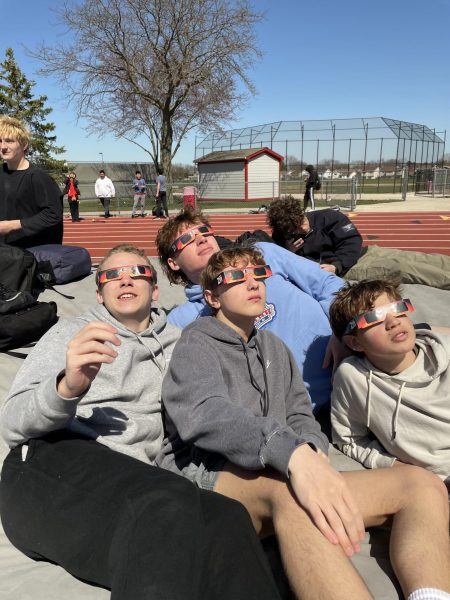
Throughout PHS history, the science department has remained active in educating students and organizing events, including the 2024 solar eclipse viewing.
“With limited resources, we still joined the rest of the world in looking up and engaged in a centuries-old practice,” astronomy teacher Sean Fisher-Rhode said.
Fisher-Rhode holds a NASA certification through the Endeavor STEM Teaching Certificate Project, allowing him to receive information about upcoming events months in advance. Using that information, he and other science teachers organize schoolwide programs.
During the eclipse viewing, administrators addressed safety concerns related to the sun’s brightness. The school provided the entire student body with protective glasses and shortened the school day to allow for observation. As the temperature dropped, the wind turned chilly and the sky slowly darkened, the moment created lasting memories for students, aided by solar scopes provided by the science department.
NASA has described Artemis as “not just a mission to orbit the moon, but the continuation of humanity’s century-long journey of curiosity, courage and persistence. We are building the future of space exploration, and that future begins now.”
From Pluto to the moon landing to Artemis II, one truth endures: Looking beyond what is familiar changes everything. For a century, that instinct to look up has carried both exploration and the student journalists who documented it forward.