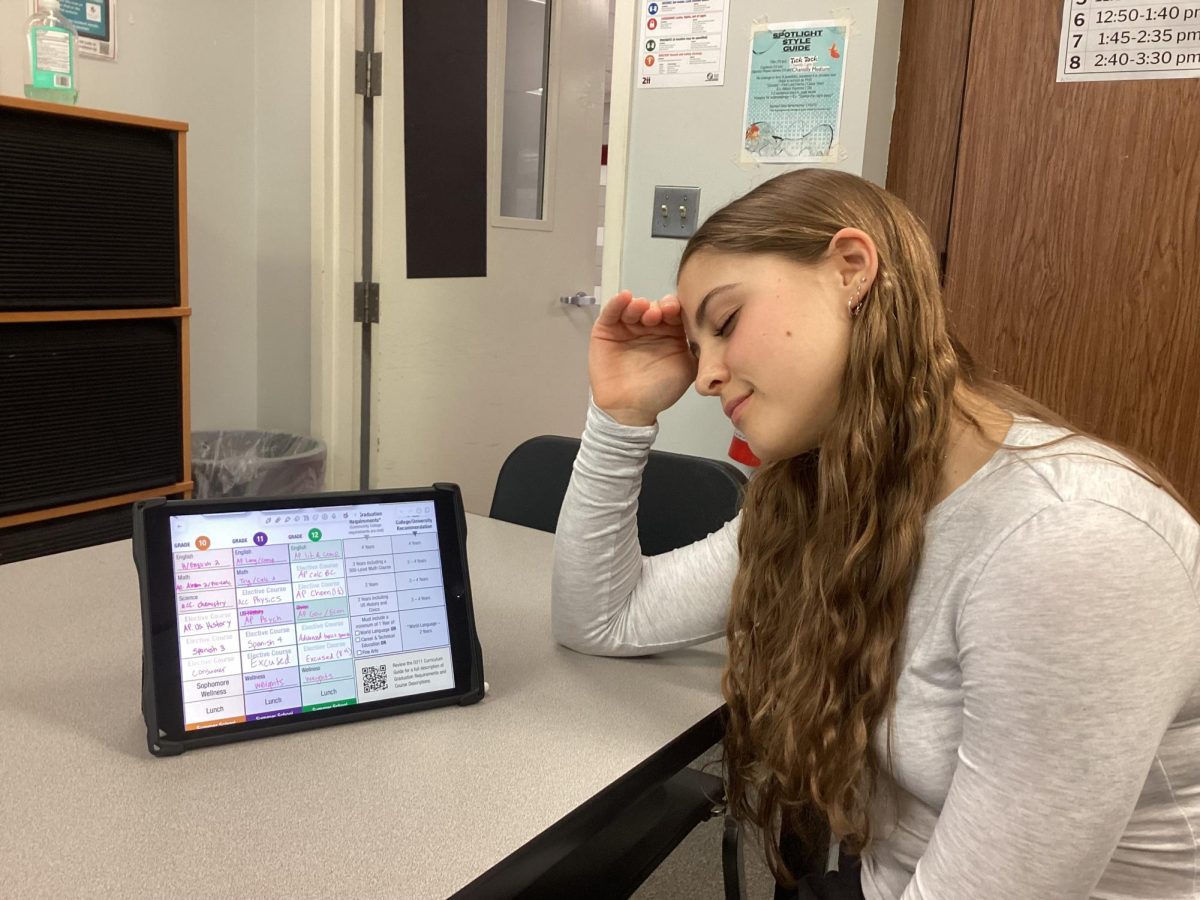
New school policies are rocking the upcoming 2026-2027 school year across all of District 211, with new standards brought forward by Superintendent Dr. Judith Campbell to enforce the present district guidelines.
For some, these changes promise more hours of sleep and a healthier balance; for others, it disrupts routines built around sports, jobs and transportation. As the district moves forward with this decision, it’s worth asking if these alterations will improve students’ academic schedules or instead disrupt learning.
The policies that are typically implemented by school districts prioritize providing equilibrium that balances students’ needs and benefits, along with financial needs of school districts. However, this change shows a heavily tilted scale towards the school district.
Beginning next year, students will be required to have a full lunch period as well as a gym class embedded into their daily schedules. Additionally, early bird class slots that begin at 7:45 a.m., which were designed for students enrolled in period-and-a-half AP science courses, will no longer be offered up for selection.
“Being in early bird AP Biology right now has allowed me to have a full lunch period which is extremely useful,” junior Eesha Pradhan said. “I can use it as a study hall, or I can even go home if I want to. It’s given me a lot of flexibility, and I’m really happy I was enrolled in early bird this year.”
The removal of early bird classes raises concern for students like Pradhan who have relied on the flexibility these periods provide. Early bird courses allow students to better manage demanding academic schedules by freeing up time during the school day. This spare time is not a luxury, but a necessity which enables us to balance advanced schoolwork with extracurricular commitments, employment or personal responsibilities.
“Taking away early bird opportunities definitely makes it harder to fit in elective classes,” Pradhan said. “If I were to have an early bird class, I would have one free period. For example, I’ve always wanted to take AP Psychology. I could have fit that in, so it’s kind of disappointing for all these new policies to come in and change my plans.”
The largest and most unexpected change coming into effect next school year is the dissolution of the gym waiver. Previously, students were allowed to prove that a university required them to take a specific course, which would then replace their gym period. Counselors, looking to provide their students with as many opportunities as possible, were able to grant these requests.
However, this possibility was often exploited as an excuse to get out of a gym period, allowing students, particularly seniors, to glide through a less demanding class.
The gym waiver is also impacted by the early bird policy change, with students being able to take a full period of physical education before the start of the school day. Taking early bird gym classes allowed students to have an additional period of free time, either to go home or take another class.
“If students have a desire to walk away from Palatine High School with additional electives that would provide knowledge to apply to their future, these changes do limit their exposure to those courses,” Counselor Rick Splitt said. “I’m a big believer in taking classes which broaden your skills and strengths in order to figure out your interests.”
Opportunities to explore a diverse range of specialized areas, spanning from medical sciences to engineering, are abundant at Palatine High School. The district provides substantial funding for advanced instructional tools, including an anatomy table and 3D printers, which enhance hands-on learning. Through access to these resources, students are able to enroll in specialized courses, develop practical skills, and expand their competence in selective career pathways, better preparing them for both higher education and future professions.
Splitt later said that the termination of the gym waivers would not affect students’ ability to complete all necessary requirements for graduation.
Amid all schools in District 211, specifically Palatine is facing an upcoming problem. Statistics show that the class of 2030 will be significantly smaller than the current graduating class, which is driving the school and district to start reacting to this change.
“The reason we started offering early bird classes was solely due to classroom space,” early bird AP Physics teacher Megan Gabrielson said. “As enrollment grew, it became necessary to offer additional classes during the early bird section to fit all required courses.”
With the decreasing enrollment class size, early bird classes are slowly becoming the first reaction that the district and Palatine are taking away to combat wasteful use of resources.
The limitations on early bird and gym periods have always been stated in the board policy handbook according to Palatine’s principal Tony Medina. The changes are not a rewriting of these policies, but simply enforcement under the new superintendent.
After dissecting and weighing the reasons for scheduling changes and how students will be impacted, the editorial board sides with the students. Students’ routines, schedules and goals are severely influenced by these guidelines, while the district slightly prepares for the class enrollment size to decrease, which won’t impact the school for two years.
Further discussions between teachers and administrators reveal that many staff members were not aware of the changes themselves, leading to a deficiency in communication among students, counselors and parents. In other words, students were not informed fully about the new limitations until the day of academic scheduling for the upcoming school year. This lack of disclosure led to much confusion and disappointment when students were not able to enroll into their desired courses.
In addition, the editorial board finds that teachers and administrators did not show interest in students’ opinions on the changes, or even offer additional support to accommodate schedules based on other available methods to increase student success.
These changes create a lockout for students to succeed in university applications. As post-highschool programs become increasingly challenging to enter, these recent policies complicate the application process further. Instead of offering students a path to success, they create additional hardships.